
Let them have a go. We're not moving.
Phorvex is live. Try to contain your excitement.
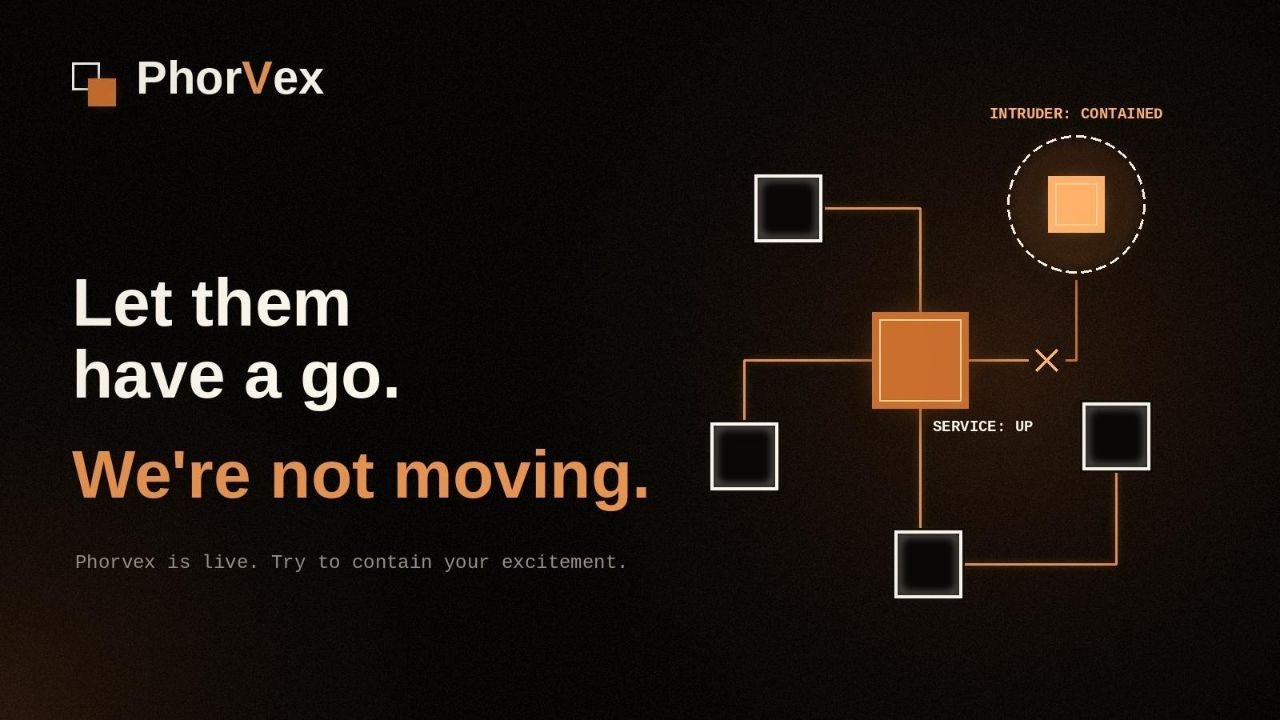
Somebody is attacking your infrastructure right now. Probably several somebodies, plus a few bots and an AI agent that never sleeps and has no shame. Congratulations, you're on the internet.
The Industry Plan
Detect. Alert. Escalate. Wait for a human to find his glasses.
The new, improved version has one model watching another model and reviewing the footage after everyone has gone home. That isn't security. It's a smoke alarm that files its report on Friday.
Nobody Wants to Press the Button
Detection got fast. Response didn't, and the reason is rather sad. Every option on the menu is destructive. Kill the pod. Wipe the node. Rotate the lot. On a stateful cluster that's how you lose quorum, and you've done the attacker's job for him, free of charge. He came for chaos and you delivered it yourself, with a bow on it.
So the button sits there, a human holds a meeting, and the intruder helps himself to the biscuits.
Our Answer: Boring on Purpose
Phorvex is a response layer. It runs one loop: observe, score, prove it won't break anything, act, audit. No model in the decision path. No clever diary to forge, no second brain to charm. Same input, same decision, every time, and a log that can be read by someone who wasn't there.
The proof is the bit that matters. Before it touches anything, Phorvex checks that the action won't take the thing it's guarding down with it. If it can't prove that, the destructive option is vetoed and it picks something gentler. A sensible adult in the room, in other words. Rarer than you'd think.
The Receipts (Names Withheld, Lawyers Insist)
We'd tell you whose cluster it was, but then somebody with a lanyard would have to shout at us.
What we can say is this. A three-replica, quorum-based cluster on Kubernetes. A live container-escape attempt aimed at the leader, because we're not savages and we picked a worthy opponent. The textbook response, delete the compromised pod and let it rebuild, would have broken quorum. That's the move that makes the attacker's day, and also yours, in the worst way.
Phorvex looked at it, said "no, you absolute vandal," and quarantined him instead.
- Time to evict: 20.15 seconds. About how long it takes a manager to find the meeting invite.
- Data lost: none. We counted.
- Quorum: intact. Two of three replicas never stopped talking, which is more than most committees manage.
- Downtime: zero. The only thing that went offline was the attacker's plan.
The attacker arrived with ambitions. He left with a quarantine and a lot of time to reflect. He had a miserable afternoon. The service had a dull one. Dull is the product.
What We Won't Tell You
That it can't be attacked. Everything can be attacked, and anyone who says otherwise is selling something. We say that taking it down is hard, and that doing it makes more noise than a dropped tray.
Kubernetes is proven. The AI inference side is built, with hardware validation still underway. We'd rather tell you now than have you find out in a meeting.
The Bottom Line
You won't stop every foothold. Don't be daft. What you can decide is whether a foothold turns into an outage. Throwing him out is the easy half. Doing it without wrecking the house is the half nobody had managed.
We're taking a handful of design partners: two to three weeks, free, scored on time to contain, zero downtime and zero data loss. Bring your worst.
Get the next one when it lands.
No schedule. We write when there is something proven to say.